

Food inequality, like the carceral state, is not a bug, but a feature.
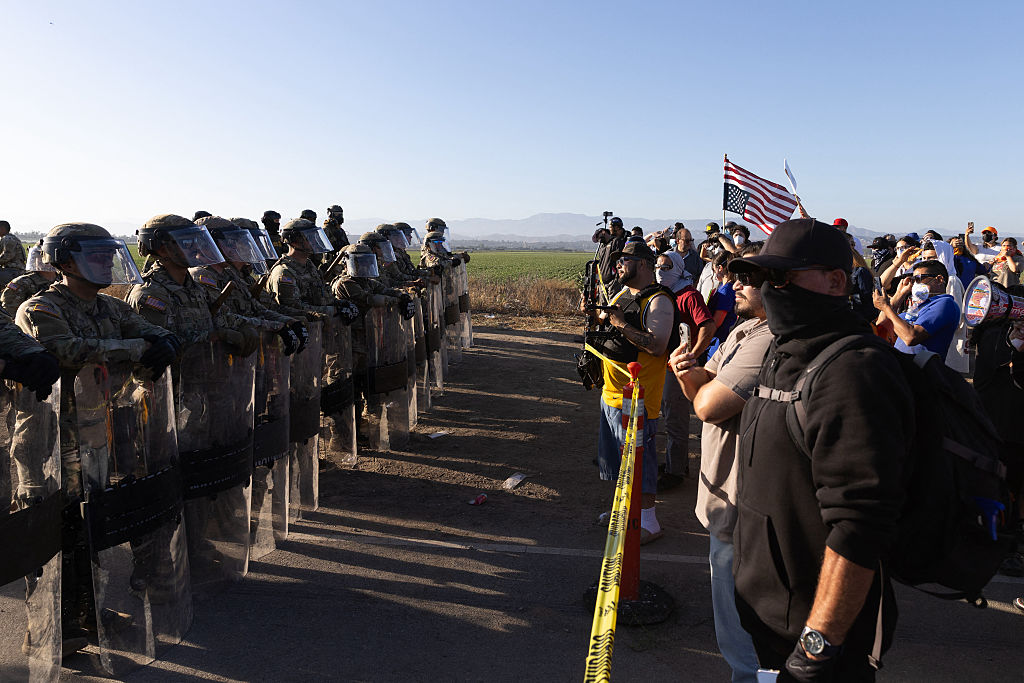
California National Guard troops face off with protestors during a federal immigration raid on Glass House Farms in Camarillo, Calif. on July 10, 2025. Photo Credit: Blake Fagan via AFP
In June 2025, ICE agents walked into Glenn Valley Foods, a meat plant in Omaha, Neb. and detained roughly half the workforce. Production sagged to a fraction of normal: Producers were already strained by drought, thinned herds, and high cattle prices. On paper and in headlines, the Trump administration claimed an enforcement success; on the plant floor, workers stayed home, choosing to lose wages rather than risk returning. Beef processors warned that if raids became routine, they would buy fewer animals, and bottlenecks would pinch slaughterhouses and feedlots. The systemic shock emerged in the price of ground beef, which edged, at one point, towards seven dollars a pound. Still, raids were sold to voters as proof of control, even as they paid more for food and meals.
ICE actions against food workers, already exhausted and criminally underpaid, have a demonstrable effect on sky-high food prices and our tax dollars: Raids further strain an already fragile, extractive food production and service system by not only further funding violent carceral systems, but also our fiscal ability to put food on the table. And while it’s clear that much needs to be changed when it comes to how we treat food workers–from livable wages and health insurance to legal protections and affordable housing –one thing has not been properly acknowledged. ICE interference shapes how we eat and our ability to have food sovereignty.
By definition, food sovereignty is, first and foremost, a claim to power. It is the right of communities, including immigrant food workers, to decide how food is grown, who profits from it, and what it costs. True self-determination means the land and our labor serve everyone, rather than corporations or government agencies. It means the price of food stays low and steady enough that working-class households eat well, that profits are shared so that small farmers, migrant workers, and food workers can live with dignity and comfort. But this is far from the reality we face today: with grocery and restaurant bills rising and food workers one threat away from deportation, what we are left with is a food system benefiting corporate interests, flanked by a carceral force wearing a false claim to justice as a mask.
Immigrant food workers carry the nation’s appetite on their shoulders: According to a 2020 study by the American Immigrant Council, over 20% of food industry workers are immigrants. Within agriculture, 40-50% of workers are undocumented on any given year, while in the restaurant industry, undocumented immigrants are 10-15% of the workforce. Their work is in our carts, fridges, and pantries, on our restaurant tables, takeout counters, and drive-throughs. Workers are keenly aware that ICE knows exactly where to detainthem to hit their arrest quota: in fruit orchards and vegetable farms, meat processing plants, egg barns, dairy plants, grocery stores, restaurant kitchens, and even the parking lots where they gather at dawn, hoping to find work for the day. With agents detaining and deporting workers regardless of immigration status or criminal record, workers are scared into staying home, giving up precious income just to live another day. Meanwhile, fields go unpicked, stores scramble to cover shifts, and kitchens stall. Crews thin out rather than risk being taken, or, as in the case of Jaime Alanís García, are killed while fleeing an ICE farm raid.
These calculations between fear and courage in the face of aggression are not abstract to me; they’re personal. My father was an undocumented immigrant who worked nights stocking a cereal aisle. He was given thirty-two hours a week, just shy of full-time, so the grocery store could avoid providing health insurance. When a new manager began to ask employees for identification, my dad and other undocumented co-workers quit, leaving the store scrambling to find people willing to work for minimum wage, nearly full-time, with no healthcare. These violent acts move through the food chain under the guise of “rising prices,” a surcharge in our grocery carts and restaurant bills.
The U.S. government has played with the lives of immigrant food workers many times before. Under President Herbert Hoover during the Great Depression, “Mexican repatriation” campaigns deported hundreds of thousands of Mexicans and Mexican Americans, many of them farmworkers recruited in boom years, as officials caved to white workers, who were both unwilling to cede the work to immigrants or to take on the low-paying farm jobs themselves. Filipino farmworkers, known as the Manongs, were treated similarly: in the 1920s and 30s, Filipino workers slept in crowded bunkhouses, were paid low wages, worked through illnesses such as tuberculosis, and were given no path to citizenship, even though the Philippines was then a U.S. territory. In January 1930, white mobs in Watsonville, Calif. hunted Filipino men, beat them, threw them off bridges, and shot and lynched them. Soon after, California banned marriage between Filipinos and white people, and Congress slashed Filipino immigration to a token quota. The food industry has long built itself on brown people’s labor while the law denied them basic human rights. At the root of it all is a sinister plantation logic: a nation’s wealth and abundance built on enslaved Black people’s labor and deprivation. It’s just new bodies in the fields, now.
Today’s arrests and deportations are a continuation of this very logic: exploited migrant workers are still denied basic rights and protections while the food industry that employs them grows, year on year. Many lack legal status; many more live in mixed-status families. Using the excuse of “border security,” ICE and DHS agents press on that vulnerability by design. As a result, fear of ICE enforcement becomes a cost itself, narrowing what people can afford and where they can eat. These enforcements, carried out without input the food industry or local communities, and often against their will, directly impact our food sovereignty—how people determine the way food is grown, distributed, made, and served, as well as how workers within the food industry are paid and treated.
Take summer 2025 as an example: ICE raids swept through produce fields around Oxnard in California’s Ventura County, arriving in unmarked vehicles (and sometimes helicopters) at the height of harvest. The raids spread, so crews went into hiding: one Ventura County grower estimated that roughly 70% of workers vanished from the rows almost overnight, leaving farms heavy with rotting produce and no one to pick it. Economists modeling removals of migrant farmworkers from California estimate that growers could lose up to 40% of their workforce, wiping out billions of dollars in crop value and raising produce prices by as much as 10%.
These losses are passed on to communities and households, obfuscating why and how the increases happened in the first place. The American consumer is consequently exploited, too, absorbing the real labor cost of detentions and deportations. In Los Angeles, immigration sweeps in June 2025 hit downtown produce markets and surrounding eateries; vendors called business “worse than COVID” as customers vanished and supplies wasted away in storage. In January 2026, along Lake Street in south Minneapolis, immigrant-run spots like Lito’s Burritos and stalls at Midtown Global Market, a popular food hall in downtown Minneapolis, saw revenue plunge due to ICE enforcement, forcing them to cut hours, or close altogether. In nearby St. Paul, Minn., El Burrito Mercado shut down after its owner watched agents circle the building “like a hunting ground.” Meanwhile, four ICE agents ate at El Tapatio, a restaurant in Willmar, Mn. Hours later, they returned after closing time to arrest the owners and a dishwasher. Hmong restaurants and Mexican groceries across the Twin Cities have gone dark for days or weeks at a time, suffocating the local economy, leaving consumers with shrinking access to food, and small business owners with no revenue while their employees go unpaid.
If food sovereignty means real control over how food is grown, distributed, and accessed, it must begin with the safety of the workers holding the system up. Workers’ wellbeing is not ornamental: it is the precondition for steady harvests, stable prices, and an affordable Main Street. Federal and state legislation must build strict firewalls between labor and immigration enforcement so that workers can file complaints, call inspectors, or take a sick day without fear. Laws can enforce and extend safety protections, wage standards, and the right to unionize. This can only happen with comprehensive immigration reform: A durable legal status and a path to citizenship for food and farmworkers would help immigrant families break the old pattern of being extracted for labor while being denied the basic right to stability.
There are also infrastructures that must be abolished to truly achieve food sovereignty: specifically, the burgeoning immigration detention industrial complex. The Big Beautiful Bill allocated $75 billion dollars, spread over four years, to ICE, funding the expansion of private prison facilities. Alongside the nation’s existing prison industrial complex, the immigration detention industrial complex has become a key economic driver, albeit one that benefits only a few, such as shareholders in CoreCivic and Geo Group, two of the nation’s biggest private prison companies.
Food inequality and lack of food sovereignty, like the carceral state, are not bugs, but features: soaring food, housing, and healthcare costs, voter discontent, and public unrest form a feedback loop, reinforcing the manufactured narrative scapegoating immigrant and migrant workers. If enough Americans believe that immigrants are to blame for the high prices in grocery stores and restaurants, no one will pause long enough to scrutinize the corporations (and owners) who stand to profit.
Should legislators have the courage to change the infrastructure that allows these inequities to occur, the hands that harvest, pack, cook, serve, and wash would be fairly recognized as part of the nation they feed. Because fear and imprisonment should never be priced into the dinner table. Everyone can—and should be able to—eat.